UA-41049660-1

Wednesday, 18 December 2013

Hey you..the “average” employee sulking in the corner! Stop agonising over your performance review! Absorb..think..plan. Now can we move forward?

I participated in an on-line discussion on performance management where the discussion rotated on the perennial concern that most managers do a poor job in handling the mechanics of the process and create tremendous angst amongst employees by using stack ranking that can lead to an assessment or rating that has the potential to negatively impact employee engagement. This is inherently a challenge as most employees (particularly those at low levels of actual performance) always rate their performance far higher than what it really is thus leading to a mismatch during the review with the manager.

The discussion meandered to an interesting observation -- that there was a possibility that performance management discussions (between manager and employee) could leave those employees who have met their objectives and delivered against them feeling disappointed as they end up being part of a majority of employees. The feeling was that such employees would consider themselves "average" due to their assessment placing them in the majority.

There is far more focus on the two extremes i.e. the high performers and the low performers that sometimes managers forget that it is those employees who are part of this majority that keep an organisation functioning and thriving.

My own experience has taught me that managers need to spend time on performance managing and coaching this majority as there is a possibility that they may be impacted by a sense of relative deprivation. This is a feeling where an employee believes that he or she may not have been given (i.e. deprived off) a perceived positive outcome for which they have a sense of entitlement. Relative deprivation as a theory is related to issues such as organisational justice, equity and fairness, hence a critical element to understand the response that many employees formulate to what is essentially a perception problem that needs to be handled by managers (rather than ignored) as it can lead to stress, desire to leave and counter-productive behaviour on the part of the employee. In an era, where the psychological contract with an employee is already at its lowest (due to on-going rapid change, competitive pressure and the perennial search for cost advantage/productivity) it is critical to focus on this pool of performers as it is a the largest proportion of any employee base. [Top performers usually suffer from a different issue -- “when a deprived person compares himself with a non-deprived, the resulting state will be called relative deprivation. When a non-deprived person compares himself with a deprived person, the resulting state will be called relative gratification."]

Rather than use the above discussion as a basis for making another plea for over-sight and structure on the part of people managers I am on this occasion seeking to focus on “average” employees who need to make sense of their performance review (the risk that it is complicated by the manner the manager handled it is still there but not the focus any more!). Most managers are so caught up with identifying and focusing on the two extremes (i.e. the low performers and the high performers) that they forget the large proportion who form the back-bone of their organisation! My instinct believes that much is to be gained by focusing on this group as well. 

For those employees who are unsure of their status due to inclusion in the majority and thereby being perceived as “an average employee” my suggestion is to first realise that being part of a majority does not make you “average”! Being part of the collective is a good starting point but also a territory that is by design destined to 'potentially' remain in the shadows.

The onus is on you is to work with your manager to decipher his or her take on your performance. My first performance rating with my manager nearly two decades ago was absolutely agonising as I walked in with an assessment that I could walk on water and my manager cut me down to size and placed me with the majority. My first reaction was disbelief but I sat with him and worked through my performance review by focusing on the way forward. I did this because I had no idea on what else to do or how to respond to that assessment. The good news is that I had a great discussion and it set the benchmark or tone for the way forward for the rest of my career as he outlined what better than average performance meant for him and why some of my peers did a better job at it that I had!

Your discussion has to be meaningful. Rather than spend time on having your manager tell you about what is wrong with you, aim to steer the conversation to what you could do better to get a better rating and stand-out from the majority. This is where having a good record and structure of the requirement of your job helps as well as having recorded developmental objectives that you hold yourself accountable to. In the end, life is not fair. Luck may have a play and perhaps your sense of trepidation is not unwarranted.Don’t forget that things are all relative and there is a small group that is perhaps entitled to a good sulk and introspection due to a rating discussion but avoid being part of that small group. I concede that human nature is always to look at those better off than yourself and then let relative deprivation related angst drive you up a wall!

The real question is whether you were aware of what your manager thought of you before you walked into your performance review? Have you taken direct guidance and advice from your manager along the way? Did you take the platitudes but shied away from absorbing or listening to the developmental guidance on how you can move forward or become a better employee? A good manager can help on both counts! If possible, I suggest that you also seek out a Mentor to get professional and personal input into your style of functioning. They are role models who can help you open both mind and heart!

You are accountable and responsible for your career. Not your manager! I suggest that you create a balance-sheet of your assets (strengths) on the left and liabilities (weaknesses) on the right. For those of you who consider weakness a politically incorrect term then feel free to substitute this with the term “area of development”.  
Ask yourself a series of honest and simplistic questions to prompt a detailed listing of strengths and weaknesses. Read and rewrite what you have put down for relevance and brevity. Many also extend this analysis to the traditional SWOT by adding O(pportunity) and T(hreat) but I recommend that it is sufficient to work on the S(trength) and the W(eakness) of the SWOT. Now comes the bad news. Review this with your manager. Great if you can do this early in the performance review cycle but a great start after your review is completed as well. You do this the right way and you will start to figure out a much better way to react to your rating rather than sulking in the corner! This will help in creating an action plan that is based on fact rather than ‘emotional fiction’. 

In the end, remember this simple reality -- "Most managers actually don’t want to undertake a performance review that leaves any employee demotivated." Relative deprivation can be used as a motivator rather than a crutch for your emotions!

____

Please feel free to subscribe via email (on the right use 'follow by email' feature) and also consider sharing with others using the links/tools provided below. Your email address is not accessible to me and you can unsubscribe any time you want! This is the best way for me to broaden my reach and increasing my blog's visibility. Thanks in advance for your support!

Friday, 6 December 2013

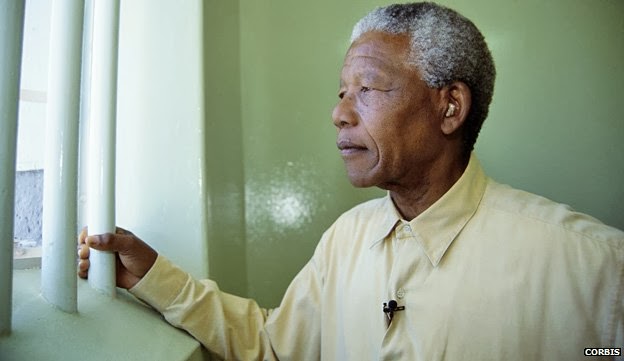
Goodbye Madiba :: Three simple lessons from Nelson Mandela to emulate at work

18th July was Nelson Mandela’s birthday and on that occasion I had blogged on three simple lessons from Madiba's life that even participants in the 'corporate rat race' could be inspired from and emulate easily. I have chosen to refer to him by his clan name of Madiba. There is no better tribute to a leader than to address him in a manner befitting his stature and humility.

At that point I had shared the following as he was severely ill and the worst was expected.
“Though we are approaching a world without Mandela, his lesson lives on in each of us. It lives on whenever we choose the transformative power of forgiveness, whenever we choose let go of our narratives about our past and chart a new future” (Behnam Tabrizi).

Now as we close of the year 2013 I am re-blogging my earlier blog as the worse has occurred. Madiba is no more. 


He was the reason why I invest a large portion of time on developmental activities with others. What gives me purpose is the following that he outlined in his book 'Long Walk to Freedom' -- “And as we let our own light shine, we unconsciously give other people permission to do the same. As we are liberated from our own fear, our presence automatically liberates others.”
For me he is not only an asset for South Africa but an asset for the world! I consider him as a personal hero; a symbol of peace and unity. I hope that observing his life's work might make the corporate world more 'humane'! As he now passes into the after-life I wonder whether he has got an answer to one simple question that might be nagging him – “Did I complete my life’s work?” For me he did and I hope that the we keep striving at a personal level to keep his legacy going on even after his passing.

Lesson # 1 : People are capable of changing for the better

Madiba’s life story shows his transition from being a radical (who at one time espoused and positioned violence as a fair means to achieve freedom) to a pacifier who came out of prison (after twenty-seven years) to align with a non-violent and peaceful way for dismantling
apartheid.

I find the following by
Richard Stengel (2008) as a powerful exposition of the change that occurred along the way -- “Ultimately, the key to understanding Mandela is those 27 years in prison. The man who walked onto Robben Island in 1964 was emotional, headstrong, easily stung. The man who emerged was balanced and disciplined. He is not and never has been introspective. I often asked him how the man who emerged from prison differed from the wilful young man who had entered it. He hated this question. Finally, in exasperation one day, he said, "I came out mature." There is nothing so rare — or so valuable — as a mature man.”

I view this as a sign that people can grow and develop over time given the right circumstance and environment. How many times have I seen managers label individuals and their performance in a negative manner thereby rendering the individual as being incapable rather than someone needing assistance or guidance that could be channelled for positive change! I always start from the basis that people can change or be changed for the better and hence try a reconciliatory approach when dealing with a reportee who needs support in completing their organisational objectives.

Lesson # 2 : Sacrifice is needed when pursuing the right goals and objectives

My first exposure to Madiba was the first few years of his release from prison i.e. he early 90s when I lived in South Africa. I was always captivated to watch a man who gave twenty-seven years of his life in prison but walked out and extended an olive branch to those that kept him locked away from the world. To me it signified the ultimate sacrifice (and inherent ability to forgive) in support of one’s belief(s).

"During my lifetime I have dedicated myself to this struggle of the African people. I have fought against white domination, and I have fought against black domination. I have cherished the ideal of a democratic and free society in which all persons live together in harmony and with equal opportunities. It is an ideal which I hope to live for and to achieve. But if needs be, it is an ideal for which I am prepared to die" (Long Walk to Freedom).

I have always advised people that achievement at work and in life will always come from sacrifice. Understand the same and be willing to make the necessary sacrifices if you feel strongly about a goal or objective at work or personal life. Many people talk about goals and dreams but never about what must be given up or foregone for achieving the same. Only sacrifice sets you apart from the rest. Even when you invest time you are reallocating a finite asset from one area to another (for e.g. this could mean less time with your family & friends!).

Madiba’s ability to sacrifice was also a benchmark for me whenever I was down or felt that the world was against me. I felt that my own 'suffering' or angst took on a different meaning when juxtaposed against another person’s suffering. As the saying goes "I felt sorry because I had no shoes, then I met a man who had no feet.” You will feel much better and less burdened if you can give relative context to what you are really suffering or burdened with. One simple situation is where we watch others getting ahead of ourselves and are consumed with jealousy without realising that there may be others that look at you and also feel that you are ahead of them.

Lesson # 3 : Be inclusive and visible when dealing with others

I watched in astonishment as Madiba emerged from prison and sought forgiveness for the minority that had put laws in place to suppress the majority. He encouraged debate to ensure that South Africa would deliver a constitution that forged unity and equality amongst all. He gave many an opportunity to give input during the process. For me this is one of the most critical aspects of his leadership aura. By giving people say in a process you instil a sense of ownership and commitment to the process.

“One of the things I learned when I was negotiating was that until I changed myself, I could not change others” (Long Walk to Freedom).


In the movie ‘Invictus’ there are many scenes where Madiba is shown taking carefully choreographed steps to send a clear message to white South Africans by supporting the national Rugby team (the Springboks). He knew that open support would ensure that the nation would rally around a common point and that sport could be the unifying glue at a very critical time in the history of South Africa (the Rugby World Cup was in 1995 just after the 1994 elections). At work also there are many people who are dissenters or devil’s advocates. Your aim should be to include them in all debates and not aim to nullify or marginalise such voices. It is these voices that will shape the best decisions and force you to question your beliefs and dogmas.

“For to be free is not merely to cast off one’s chains, but to live in a way that respects and enhances the freedom of others.” (Long Walk to Freedom).

At times many would not realise that they are being steered in a certain direction as Madiba would painstakingly hear all out and then set up an argument to ensure that people felt that it was their own thoughts that had been shared that had led to the decision or outcome. One of his quotes that outlines this strategy is “A leader. . .is like a shepherd. He stays behind the flock, letting the most nimble go out ahead, whereupon the others follow, not realising that all along they are being directed from behind” (Long Walk to Freedom).

I had the privilege of observing Madiba at Johannesburg's Oliver Tambo International Airport more than a decade ago. Even then I was amazed by his ability to create an engaging environment with all that came within range of him. His presence soothes but it also reflects that he is acutely aware of the impact that his presence has on people and that his every small action/gesture is being watched and emulated by many. Each action he takes or does not take is critical to how people view him.

“Appearances matter — and remember to smile” (Long Walk to Freedom).


____
Please feel free to subscribe via email (on the right use 'follow by email' feature) and also consider sharing with others using the links/tools provided below. Your email address is not accessible to me and you can unsubscribe any time you want! This is the best way for me to broaden my reach and increasing my blog's visibility. Thanks in advance for your support!

Tuesday, 3 December 2013

Selected words of wisdom from 'Life's Little Instruction Book I, II, III' by H. Jackson Brown, Jr.

I have a habit of sharing quotes and messages with others and decided to share a list of fifty selected quotes or instructions from a series of books by H. Jackson Brown, Jr.

This is a different post than my normal posts but I sincerely believe that if the advice below were to be heeded then the the corporate world would be a much better place!

  1. A racehorse that consistently runs just a second faster than another horse is worth millions of dollars more. Be willing to give that extra effort that separates the winner from the one in second place 
  2. Accept the fact that regardless of how many times you are right, you will sometimes be wrong 
  3. Admit your mistakes 
  4. Be a leader: Remember the lead sled dog is the only one with a decent view 
  5. Be an original. If that means being a little eccentric, so be it 
  6. Be brave. Even if you’re not, pretend to be. No one can tell the difference 
  7. Be decisive even if it means you'll sometimes be wrong 
  8. Be grateful that God doesn't answer all your prayers 
  9. Be willing to lose a battle in order to win the war 
  10. Bestow a favour and then forget it 
  11. Commit yourself to constant improvement 
  12. Don’t be afraid to go out on a limb. That’s where the fruit is 
  13. Don’t burn bridges. You’ll be surprised how many times you have to cross the same river 
  14. Don’t say you don’t have enough time. You have exactly the same number of hours per day that were given to Pasteur, Michelangelo, Mother Teresa, Helen Keller, Leonardo Da Vinci, Thomas Jefferson, and Albert Einstein 
  15. Don’t spread yourself too thin. Learn to say no politely and quickly 
  16. Don’t use time or words carelessly. Neither can be retrieved 
  17. Don’t waste time grieving over past mistakes. Learn from them and move on 
  18. Don't allow self-pity. The moment this emotion strikes, do something nice for someone less fortunate than you 
  19. Don't be rushed into making an important decision. People will understand if you say, "I'd like a little more time to think it over. Can I get back to you tomorrow?" 
  20. Don't do anything that wouldn't make your Mom proud 
  21. Don't expect life to be fair 
  22. Don't waste time learning the "tricks of the trade." Instead, learn the trade. 
  23. Every once in a while ask yourself the question, “If money weren't a consideration, what would I like to be doing?” 
  24. Every person that you meet knows something you don't; learn from them 
  25. Get your priorities straight. No one ever said on his death bed, ‘Gee, if I’d only spent more time at the office’ 
  26. Give people more than they expect and do it cheerfully 
  27. Just because you earn a decent wage, don't look down on those who don't. To put things in perspective, consider what would happen to the public good if you didn't do your job for 30 days. Next, consider the consequences if sanitation workers didn't do their jobs for 30 days. Now, whose job is more important? 
  28. Laugh a lot. A good sense of humour cures almost all of life's ills 
  29. Learn to disagree without being disagreeable 
  30. Learn to listen. Opportunity sometimes knocks very softly 
  31. Leave everything a little better than you found it 
  32. Live so that when your children think of fairness, caring, and integrity, they think of you 
  33. Never remind someone of a kindness or act of generosity you have shown him or her 
  34. Never underestimate the power of words to heal and reconcile relationships 
  35. Never underestimate your power to change yourself. Remember that overnight success usually takes about fifteen years 
  36. Practice empathy. Try to see things from other people's points of view 
  37. Remember that 80% of the success in any job is based on your ability to deal with people 
  38. Remember that all important truths are simple 
  39. Remember, it's not your job to get people to like you, it's your job to like people 
  40. Seek opportunity, not security. A boat in harbour is safe, but in time its bottom will rot out 
  41. Share the credit 
  42. Success is getting what you want. Happiness is liking what you get 
  43. Take care of your reputation. It's your most valuable asset 
  44. The importance of winning is not what we get from it, but what we become because of it 
  45. Treat everyone you meet like you want to be treated 
  46. Understand that happiness is not based on possessions, power or prestige, but on relationships with people you love and respect 
  47. Understand that happiness is not based on possessions, power or prestige, but on relationships with people you love and respect 
  48. Watch for big problems. They disguise big opportunities 
  49. Worry about the consequences of the choices you make before you make them - not afterwards 
  50. Your mind can only hold one thought at a time. Make it a positive and constructive one.
____

Please feel free to subscribe via email (on the right use 'follow by email' feature) and also consider sharing with others using the links/tools provided below. Your email address is not accessible to me and you can unsubscribe at any time! This is the best way for me to broaden my reach and increasing my blog's visibility. Thanks in advance for your support!

Saturday, 30 November 2013

Why is common sense so uncommon? (or what were you thinking when you took that decision?)

A tag-line in my LinkedIn profile states that I am fascinated by why common-sense is fairly uncommon? I put this up on my profile more than five years ago and since then have had the opportunity to explain my point of view to a few bold souls who did ask me what it meant. Some accepted my point of view but some debated and life went on. However, after five years of rumination, I am still struggling to understand why people (particularly in the corporate world) do not appear to have progressed much on this front and still leave common sense in abeyance on a consistent basis.

Common-sense in simple terms is “a basic ability to perceive, understand, and judge things which is shared by ("common to") nearly all people, and can be reasonably expected of nearly all people without any need for debate.” For me, lack of common-sense is when people miss out what others might consider obvious and apparent (to both eye and mind). Something that should have triggered a straight-forward response seems to have invoked a contrary response that defies common logic or shows an absence of alertness, which others take for granted or expect when dealing with other humans.

I concede that the term ‘obvious’ is relative as we know that one man’s dinner may be something that is sacred for another! What appears to be obvious to one person’s frame of reference may not be obvious to another person’s frame of reference but in general it is implicit that the norm is considered universal. For e.g. it is generally understood that that hitting someone in the face with a hammer forcefully will lead to severe damage, even if someone has never seen a hammer! So I can with some sense of certainty state that someone who does that and then is surprised by the outcome is possibly devoid of common-sense? (or just full of nonsense as one of my colleagues chirped when I used this metaphor!).

The basic premise of common-sense is that it is something acquired naturally rather than learnt from books. It is deemed to be an awareness that is within and not coming from without (from books or from an education?). My instinct says that common-sense is also a function of how an individual person acquires data and then applies it to gain experience. Do remember that we as humans are more uncommon in how we think or act due to our own unique circumstance. It is not only about nature but also about how we are nurtured! At times, we need to be able to be more aware and understanding of others rather than judging others.

So why do some people seem to lack common-sense? As I pondered on a simplistic response I realised that there is no simple response to this. Some people may lack it due to experience (related to age) and due to certain cultural aspects that they inherit or adopt but I have also observed some traits and characteristics during my nineteen year corporate journey that I share as plausible explanations. These explanations invariably have their basis in cognition, which in simple terms is a group of mental processes that includes the attention of working memory, producing and comprehending language, learning, reasoning, problem solving and decision making. The human brain is a potent weapon and due to the nature of its talent also has inherent biases that can help in suspending common-sense. The intent of the outlining the reasons below is not to make you a better judge of common-sense (as observed in others) but rather help you understand the nature of what is holding you back from using common-sense!
  1. People tend to over- estimate their level of competence (i.e. ability) as they base their assessment on how skilful they think they are. In general, people tend to “over-rate” their skill level and such over-rating of skills and estimates of competence can lead to flawed decisions and judgements that are not grounded in reality (as an aside this is a critical issue that impacts performance management at most organisations)
  2. We are overly optimistic (optimism bias) in assessing our chances of success vs. our chances of failure. Our approach typically aims at maximising a positive outcome and minimising the associated risk. Linked to this is ‘confirmation Bias’, which is defined as “a tendency for people to favour information that confirms their preconceptions or hypotheses regardless of whether the information is true. As a result, people gather evidence and recall information from memory selectively, and interpret it in a biased way”
  3. Linked to the above, is when people tell me that their own particular circumstance is unique and that the probability of failure is for someone else rather than applicable to them. This is a cognitive bias referred to as neglect of probability and is “the tendency to completely disregard probability when making a decision under uncertainty and is one simple way in which people regularly violate the normative rules for decision making. Small risks are typically either neglected entirely or hugely overrated, the continuum between the extremes is ignored”
  4. We also make poor judgement calls because we extrapolate past success that was totally random (i.e. just happened to work out in one's favour) to further decisions. This is particularly true of people who make ethical transgressions that initially were small but since they were not picked up or questioned led to further and bigger dubious decisions until someone was caught out (slippery slope). I have seen people make ethical choices which in hindsight always made me ask -- "What were you thinking?." Additionally, common sense is suspended when individuals tend to look for patterns where none exist. Finding a pattern gives us the ill-founded feeling of being grounded rather than left with the abstract
  5. Another important aspect is the herd-effect or band-wagon effect, which is the tendency of people to align their beliefs and behaviours with those of a group. In simple terms, if everyone is doing it then it must be right or something that we should do as well;
  6. The final aspect I wanted to highlight is one that I have noticed at times where humans consider doing something as more important than not doing anything (the illusion of progress). I have also noticed that people adopt fatalistic attributes when making a decision i.e. take a decision and then hope that god would do something unique for them or deliver a divine outcome despite the lack of common-sense applied. In this scenario, we also tend to shun responsibility for our actions or inaction particularly when the outcome is detrimental to others and not self.

Working on this aspect is likely to help in establishing you as someone with common-sense and not get the moniker of ‘nonsense’ (poor pun but hope you get my point). My suggestion would be to review and understand cognitive biases in more detail. I am surprised that traditional organisational training and educational programmes do not provide employee friendly material on the matter of common-sense when we know that the result can only be good for all employees!

____
Please feel free to subscribe via email (on the right use 'follow by email' feature) and also consider sharing with others using the links/tools provided below. Your email address is not accessible to me and you can unsubscribe at any time! This is the best way for me to broaden my reach and increasing my blog's visibility. Thanks in advance for your support!

Tuesday, 19 November 2013

‘True humility is not thinking less of yourself; it is thinking of yourself less’ :: Is being humble a desirable attribute of a corporate leader?

It is apt to start by quoting CS Lewis on humility - “True humility is not thinking less of yourself; it is thinking of yourself less.” 

Typically the names of Gandhi or Nelson Mandela or Mother Teresa come up when one thinks of humble leaders. Such leaders exude the highest form of humility where the word humble means to be “marked by meekness or modesty in behaviour, attitude, or spirit; not arrogant or prideful.”  

It is easier to relate to this notion of humility than to think of humble leaders in the corporate world! Not many people would think of humility as a characteristic of a leader when talking about leadership in management or in how organisation's are run! The entire basis that the corporate world works on is loyalty to oneself and employee relationships enabled by compensation received in lieu of time, effort and risk (taken by an employee). 

The notion of humility in the corporate world is bound to raise eyebrows as most organisations today are faced with constant and frequent change efforts that invariably leave employees suffering from “change fatigue” and the reality that most decisions are driven in the never ending pursuit of maximising shareholder valueMy own personal view-point was that humility in a corporate leader is likely to be considered a sign of weakness. I have first-hand experience of seeing humility being misunderstood to mean indecisiveness or weakness of character whereas being humble can be simply mean putting your organisation first rather than putting yourself first (or putting others down!).

As I struggled with this notion I did think of some leaders that I met in the corporate world who did appear to be humble and whose demeanour was more in line with the perspective on humility shared by Pareena Lawrence “It is neither a sign of personal weakness nor a term of condescension. It does not mean shy, meek, diffident, insecure, lacking confidence, self-deprecating, reserved, reticent, or timid, even though people often associate humility with such characteristics. It also does not mean having a low estimate of oneself, shying away from the centre of attention or lacking the ability to inspire others.”

I particularly like this approach to humility as in the organisational context the ability of corporate leaders to subjugate themselves to a higher purpose is potentially the best way to understand what makes one a leader in the corporate world. This is easier said than done as sometimes we need to adopt a strategy that makes a leader take a 'step-down' in their mind-set and not be guided by their position on the organisational hierarchy or structure! [The title of Oliver Goldsmith’s play “She stoops to conquer” comes to mind!]. Managing one's ego is critical here. We all are egoists to some degree and the truth is that having a strong yet healthy ego (as compared to having a large yet sensitive ego!) is critical in leadership. 


I consider a leader who has humility as one who is patient, respectful, compassionate and authentic. The anti-thesis would be one who is arrogant and willing to belittle or humiliate. Being a humble leader means the ability to change and adapt i.e. learn from past mistakes but more importantly admit that one has made a mistake and have the courage to keep devil's advocates on hand to question and critique (who keep the leader honest!). I have seen my fair share of managers that never admit they were wrong (even when shown proof!) and who are quick to apportion or shift blame to others! [Watch this video on Warren Bennis’s perspective on the difference between managers vs. leaders]. 

I have found great leaders in the corporate world who are humble yet firm! Who are assertive yet know how to stop from becoming aggressive (there is a very thin line between being assertive and being aggressive). These leaders know how to show respect, care and compassion while maintaining focus on outcomes. They respect outcomes but honour the way we deliver those outcomes. Aggression and arrogance makes leaders place themselves at the centre of a conversation i.e. "I am all that matters"; whereas humility places others at the centre i.e. "we all matter."

I came across some excellent advice from John Dame & Jeffrey Gedmin who outline six simple yet excellent principles that one can adopt to develop humility as a leader:
  1. Know what you don't know
  2. Resist falling for your own publicity
  3. Never underestimate the competition
  4. Embrace and promote a spirit of service
  5. Listen, even (no, especially) to the weird ideas
  6. Be passionately curious.

I want to close with some simple words from Mother Teresa. They represent a simplistic benchmark in becoming a humble leader (or more importantly better human beings). Don't lose focus on this quarter’s performance or how your yearly performance appraisal will go but do adopt some (or all) of the tenets below to move towards a better working environment based on humility:

- To speak as little as possible of one's self
- To mind one's own business
- Not to want to manage other people's affairs
- To avoid curiosity
- To accept contradictions and correction cheerfully
- To pass over the mistakes of others
- To accept insults and injuries
- To accept being slighted, forgotten and disliked
- To be kind and gentle even under provocation
- Never to stand on one's dignity
- To choose always the hardest.


Mother Teresa, The Joy in Loving: A Guide to Daily Living


____

Please feel free to subscribe via email (on the right use 'follow by email' feature) and also consider sharing with others using the links/tools provided below. Your email address is not accessible to me and you can unsubscribe anytime you want! This is the best way for me to broaden my reach and increasing my blog's visibility. Thanks in advance for your support!

Tuesday, 12 November 2013

If I was not born with the gift of leadership then how can I become a leader? :: Three ideas to develop leadership skills despite not winning the genetic lottery!

Leadership is a much described and venerated subject. I have (on occasion) been approached by employees (co-workers, peers, direct reports etc.) seeking to understand the secrets of leadership and/or how to develop characteristics that would allow them to become a leader. Some would then also raise the point that they felt that they were on the back-foot as they were not a “natural born leader.”

Despite my natural temperament or inclination, I see tremendous danger in freely dispensing “fizzy” ideas or notions on how to become a leader to the employee standing in front of me as there is some merit in understanding “nature vs. nurture” i.e. the debate on what contributes to human development – is it “genetic inheritance” (nature) or is it “environmental factors” (nurture). Most of us consider leadership as a choice between two extremes i.e. attribute leadership to either winning the genetic lottery or to having been exposed to the right experience and learning while growing up! Frankly, my own assessment is that it is a function of both. Research on the biology behind leadership with a focus on the role of genes suggests that “what determines whether an individual occupies a leadership position is the complex product of genetic and environmental influences.”

Before I go any further I feel that we should understand what leadership is and why I am using this word rather than using the much understood (and experienced) word - 'manager'? In simple terms, a manager is one who plans, organises and coordinates; whereas a leader inspires and motivates. [Watch this video on Warren Bennis’s perspective on the differentiation]. A great definition of leadership is an articulation from Kevin Kruse“Leadership is a process of social influence, which maximises the efforts of others, towards the achievement of a goal.” 


Management literature has many theories of leadership and most frameworks that I have studied or examined gave me the distinct impression that they are designed to help one become a better manager rather than a leader (or a better leader for that matter!). For me leadership (in the corporate context) is achieved after you have become a good manager! Understand this simple reality – “Being a good manager is the best platform to become a leader!” In the work-context anything else is simply inconceivable.

Most management text-books and leadership frameworks tend to codify activities and provide a structure or theory to understand leadership. For me leadership is more abstract than that. It is an amalgam of characteristics and traits. The need of the hour is to understand that despite all the monikers and labels leadership is simply about a humane way to balance the maximisation of profit (resource management with humans being treated as an element of production) while maintaining a focus on leading humans (which is always ambiguous and ethereal). Key words that come to my mind for how I would identify or label a leader are individuals that - imbue positivity, inspire others, display compassion yet remain assertive, ensure a sense of justice & fairness in all dealings, empower & develop their followers while maintaining a sense of wholeness & integrity. Leadership is not about physical attributes. Some of the leaders I look up to are not six feet tall nor can they speak English any differently than many of us! It is what they say and what they do rather than how they say things or how they do things! [But I must admit that Charisma is commonly linked to physical attributes in any discussion on executive presence!].

Leadership is not only about the person being called a leader. It is also about the context or situation in which people display leadership skills. Hitler was a leader but in hind-sight we would shudder to use the term leader to describe him. My advice would be that one establishes what works for them rather than try to create a theory of leadership to fit into. You are what you are due to constraints in your genes but don’t let that fool you into believing that you cannot or should not invest in developing leadership skills. Many of us need help to discover our own talent and also can do with advice on “dialling-up” or "dialling-down” specific behaviours.

I must also add the simple truth from my corporate experience – "some things can be studied but some things come from work-experience (i.e. over time)!" There is a reason why a majority of leaders (in the corporate world) have grey-hair! Fortune magazine spends an inordinate amount of time on profiling “30 under 30” individuals and embellishing on how these individuals have contributed to society and the world. I respect the individuals on the list but never forget that they are outliers (i.e. extremes) and more aspirational than inspirational! For the vast majority there is a need to work on leadership by observing leaders closer to home rather than reading about them on paper!

So for those of you who thought that becoming a leader is as easy as applying shampoo ("apply..lather…rinse…repeat”) then you will be sorely disappointed. It is much harder as the fundamental thing you have to change is ..you! So irrespective of your genetic composition I would advise to focus on three ideas (areas) to become a leader or to move towards becoming a leader. [There are many other things one could review in the quest to becoming a leader and Kendra Cherry provides some broad meaningful guidance on this].

Idea # 1 : Understand yourself better as a person and as an employee

One of the biggest investments I have made is to try to better understand my psychology, personality, habits and mannerisms. There are many ways to do this and it is best that you figure out a way to have your personality type assessed and get clarity on what defines you. My understanding of myself came by undertaking common tests such as MBTI, DISC or ESCI. Along my corporate journey I have had the opportunity to see how my responses were changing along the way (by testing over multiple sittings over time). This allowed me to understand how I was reacting and how I was expected to react given the changes in my corporate profile and position in the organisational hierarchy. This advice works better for those who have access to such tools otherwise start with finding some free online assessment tools.

Another important exercise is to be able to describe yourself by spending a lot of time dong an assessment of your strengths and weaknesses. This is critical as I have used my strengths to mitigate my weaknesses. This is the truth inherent in becoming a leader. Many of us are so caught up with focusing on our weaknesses or areas for development that we forget that we can leverage our inherent strengths to minimise or mitigate our weaknesses! 

To understand myself better I have invested substantial amounts of time and effort in figuring out what makes me ‘tick’ and how to leverage the same to develop leadership skills.

Some fundamental questions that I asked myself were:

  • Do I know my strengths and weaknesses?
  • What strengths will help me in becoming a leader or role model?
  • What weaknesses will detract from my persona as a leader?
  • What strengths can mitigate my weaknesses? How do I go about investing in this aspect?
  • How do I compare to other leaders? What can I leverage? What can I do more off? What can I do less off?

The answers to these questions will lead to some serious introspection. The biggest benefit I have got from this is not only in developing skills for leadership but got an honest understanding of how my career is likely to progress given some of the negatives that I have, but more importantly given me a more mature understanding of how I have failed to mitigate or correct some of my behaviours over time. We are all not perfect BUT not all of us have learned to respect or appreciate what we have and end up spending a significant part of our lives acting and behaving opposite to who we really are and then react negatively when the 'beautiful career map that we have carved out for ourselves fails to materialise or remains elusive!

Idea # 2 : Get constructive criticism and guidance from others

I am aware that it is human nature for employees) to rate themselves far better than what they actually are. To help mitigate this I always try to validate my responses to the questions under Idea # 1 (see above) by actively seeking out constructive input, advice and criticism from peers and my manager(s). It was not an easy task as this requires immense maturity to accept input into how to become a better leader (which by inference means being a better person!). 


One aspect that worked for me was the ability to garner relationships with a series of mentors to whom I looked up to give me honest guidance leveraging their own experience in the corporate world and who I used a sounding board to gain clarity. I remind you this is not easy. I share a key insights that I got from a mentor to show how difficult it can be. My mentor stated - “You will need to develop strong listening skills”. He then  gave examples of how I could have reacted better or done better based on his experience and understanding of me. I thought about this and realised that that followers consider the skill of a leader to listen as an important sign of leadership. Just hearing someone out can establish you as a leader. This is one area that I am still working on as it requires patience and the ability to not extrapolate or infer too much while a person is talking. You have to actually listen carefully to pick up the emotional cues being sent. Those who become great leaders are great because they pick up and react to those cues, which hits the hearts of those who eventual become the followers to such a leader.

Another reality is that you need to have identified mentors who are leaders in their own right. This is easier said than done as most mentors would also want to invest in individuals that are worth investing. Ponder about this and you will realise that your actions need to make you 'attractive' enough to invest in. I have learnt a lot about leadership from leaders and by observing leaders. Ray Blunt captures this accurately in this advisory – “At the end of the day, it is leaders who grow leaders: not just someone with the title, but leaders of high character and with a deeply held core purpose who intentionally and patiently give back their hard-earned wisdom. The best conveyers of truth are those leaders who are formed over time in the crucible tests of power. They are those with the commitment as well as the knowledge, opportunity, and capacity to grow the next generation of leaders conveying their lessons of experience—tacitly.”

Idea # 3 : Learn to mentor and coach other employees

Along my corporate journey I also realised that there was a huge difference in performance managing someone vs. coaching or mentoring someone. Great leaders not only perform efficient performance management and appraisals of individuals but have the ability to nurture through mentoring and coaching. This is an element that I believe establishes great leaders from the inside rather than through a hierarchical position on any organisational chart.

Coaching and mentoring are used interchangeably but are two different concepts. Understanding their meaning and differentiation is necessary as the two require very different skills on the part of the Mentor or Coach. Coaching is…"a process that enables learning and development to occur and thus performance to improve. To be a successful a Coach requires a knowledge and understanding of process as well as the variety of styles, skills and techniques that are appropriate to the context in which the coaching takes place" Eric Parsloe. Mentoring is..."off-line help by one person to another in making significant transitions in knowledge, work or thinking" Clutterbuck & Megginson.

There are many employees who are satisfied with their managers 
(I would want to emphasise the difference between manager and leader so only using the term manager) and in employee engagement surveys I am always focused on understanding the extreme scores that allow for greater learning i.e. those scores that fall into the two extremes (either 'very satisfied' or 'very dissatisfied'). Interestingly, I noticed that those employees that are very satisfied with their managers also used specific terms to describe their managers as a 'benchmark for others'; 'passionate'; 'true leader'; 'exemplifies leadership'; 'great person'. It is my belief that there is a far larger proportion of employees who resign their bosses rather than resign from their jobs (“When employees resign, the top reason for their resignation is their relationship with their manager. People leave managers, not jobs or employers”) hence relevant to focus on this aspect!

I realised that those managers getting better scores on management surveys or those employees showing better engagement appeared to be a function of how much mentoring and coaching a manager was doing with the employee rather than the routine performance management aspects of the relationship.

After five years of formal mentoring and coaching I honestly feel that the skills associated gave me with the ability to become more aware of 

  1. How to ask meaningful questions when seeking to understand a situation
  2. How human interaction shapes perception
  3. How employees react to their managers
  4. How I could proactively benchmark my abilities as a manager and leader to what was being identified as best practice by employees
  5. Identify those elements of professional interaction that motivated and created organisational commitment as well as job satisfaction in employees
  6. How to relate and articulate the vision and ideals of my organisation to employees (without fear of retribution or ridicule)
  7. Ability to see the bigger picture of how I could contribute to my organisation through the coaching experience. 

Put this to practice and I am sure that one would start seeing the transition to becoming a leader BUT note that this requires time and effort. 

Hope the above helps in your leadership journey. Best wishes!

____ 

Please feel free to subscribe via email (on the right use 'follow by email' feature) and also consider sharing with others using the links/tools provided below. Your email address is not accessible to me and you can unsubscribe anytime you want! This is the best way for me to broaden my reach and increasing my blog's visibility. Thanks in advance for your support!

Sunday, 3 November 2013

Is your career stagnating because you are not doing enough for it or because your boss or organisation is not doing enough for it?

Last week I met an individual contributor who wanted guidance on growing his career. He wanted to become a people manager and “own” a team. I asked him a simple question “What skills do you possess or are developing that will convince managers above you that you are ready to become a people manager?” He hesitated for a few seconds and then replied with 'martyrdom' in his eyes:

“Here we go again. Always the same story! Rather than looking at my potential or my past work and being rewarded for it, I have to keep proving myself. I have paid my ‘school fees’ and now the organisation owes me a promotion.”

There is no organisation that serves careers on a plate! Despite the stories that one may have heard of an individual’s meteoric rise due to some benefactor or sponsor, there are not ENOUGH benefactors or sponsors in the corporate world to ensure this becomes systemic! Employees have to ‘own’ their ‘own’ development! Sorry to state the obvious but please forget what you were told when you were recruited or what you read in recruitment brochures as a vast majority of employees will be disappointed! [a minority will of course do everything right but still something will go wrong from either the boss or organisational point of view!]. 

Stop making career plans beyond the next few years. The era of life-long employment is dead! Constant change means that you have to keep revisiting your skills on a consistent basis! I have stopped asking the ridiculous question – “Where do you see yourself in 5 years?” with employees when discussing their careers as I am unable to map my own response to this 'pompous' question, as in hindsight I see that my career trajectory had a mind of its own! 

How does one guarantee growth for the future when we know that there are others also competing for roles? Each step up the ladder is more difficult than the last one! I am constantly surprised by the number of individuals who are unable to articulate a response to a simple query – “What skills do you leverage and what skills do you think you must still develop to get to your next role?”

When most employees attempt to answer the same they end up reflecting a mismatch as most employees tend to rate themselves higher than their true abilities as they forget that their ability or the value of this ability is in the eye of the beholder i.e. the manager. Confidence in one’s own ability is critical in how your career pans out but ensure that you do not confuse confidence with competence! The amount of time people spend in building bravado or improving their body language to show confidence has to be over-shadowed by ‘true’ efforts to build ‘true’ competence. Remember that “you can fool most of your peers and some of your managers but not all of your managers all of the time!” Confused? Read the line again. 

You do not work in a democracy. The votes that count are that of your managers (i.e. people above you). Do not confuse being popular among the 'masses' as being a relevant criteria. As Orson Welles chides -- 
Popularity should be no scale for the election of politicians. If it would depend on popularity, Donald Duck and The Muppets would take seats in senate.” 

The real question is whether you are aware of what your manager thinks of you? Have you taken direct guidance and advice from your manager? Did you take the platitudes but shied away from absorbing or listening to the developmental guidance on how you can move forward or become a better employee? A good manager can help on both counts! If possible, I suggest that you also seek out a Mentor to get professional and personal input into your style of functioning. They are role models who can help you open both mind and heart!

I always aim to promote people for two key attributes. First, their reliability (dependability) and secondly, their emotional agility (needed as one rises in the hierarchy). I firmly believe that all people who are given more responsibility get it because they are reliable and dependable and do not spend time blaming others when something goes wrong. A person is reliable when they can be trusted to do what is expected of them. This label identifies a problem solver; someone who can see the bigger picture; and is adept at eliminating surprises. As one moves up the hierarchy they need to display emotional agility. For me this is about having mental strength or resilience. Resilience in simple terms is “the capacity of individuals, communities and systems to survive, adapt, and grow in the face of stress and shocks, and even transform when conditions require it.” I felt that resilience may have its genesis in the psyche or building blocks of an individual but there are tactics that had been adopted by the executives who I consider to be ‘mentally strong’ or resilient.

So the question is whether you are ready to shake things up and move out of your comfort zone in your attempt to move forward? I find tremendous truth in the following from Michele Martin –
“We reach a place where we are ‘comfortable’--in our habits, our skills, our relationships, and the work we do on a daily basis--and rocking that boat becomes too much effort. Comfort can be good. We don't want to live our lives in a constant state of anxiety or chronic hardship. But comfort can also be the enemy. Comfort breeds complacency. It makes us believe that change will not come to us. It encourages habits of preservation and constriction that can, in turn, lead to lives that are small and in many ways, less alive.” 

Something that I would want you to write down and stick on your cubicle at work comes from Gandhi –
“Be the Change You Wish to See in the World”. 

There are many ways to try to decipher this simple advise from a great man but I wanted to share this interpretation from Niurka rather than create new wisdom on this matter -
“You have the power within you to create the life you want to live. You have the power to shape the world around you just by who you are being, and how you are communicating. The law of attraction, one of the fundamental aspects to living a life by design, explains that everything that is created in the outside world is the result of what takes place internally. Being the change you wish to see in the world starts with taking full responsibility for everything that is happening in your life.”

An extension of moving out of your comfort zone is to also maintain a healthy dose of paranoia at work. For me paranoia (within reason of course!) can be a smart on-going survival mechanism in the work-place and a critical element in maintaining your relevance. Rather than be worried by this label I became enamoured by it! Andrew Grove (ex-CEO of Intel) in his 1997 book ‘Only the Paranoid Survive’ outlined that "Success breeds complacency. Complacency breeds failure. Only the paranoid survive." The book had been an eye-opener for me very early in my career and contributed to a certain mannerism in me that ensured dynamism and an on-going healthy belief that I can do better.

The final piece of advice for you is courtesy of Dharmesh Shah (Influencer on LinkedIn) -- “The best way to earn a promotion is to do more than is expected. The best way to earn a raise is to first deliver greater value. Every successful person I know feels that hard work comes before the payoff – not after. The surest way to get a raise in the future is to do things now that are above your current salary.”

What do you think? Have I missed something?


____

Please feel free to subscribe via email (on the right use 'follow by email' feature) and also consider sharing with others using the links/tools provided below. Your email address is not accessible to me and you can unsubscribe anytime you want! This is the best way for me to broaden my reach and increasing my blog's visibility. Thanks in advance for your support!
UA-41049660-1